Skip to content

Book Overview

Oxford University Press · 2025

Food and Nutrition: What Everyone Needs to Know

From Farm to Fork and Beyond: What We Eat Matters

The second edition of Food and Nutrition: What Everyone Needs to Know (Oxford University Press, 2025) by Dr. P.K. Newby is an eye-opening and mind-bending examination where all food things are considered, revealing the truth about what we eat and why it matters, from farm to fork and far beyond. Its overarching goal: To help readers distinguish between science and diet disinformation while inspiring eaters to create healthy and sustainable diets for all.

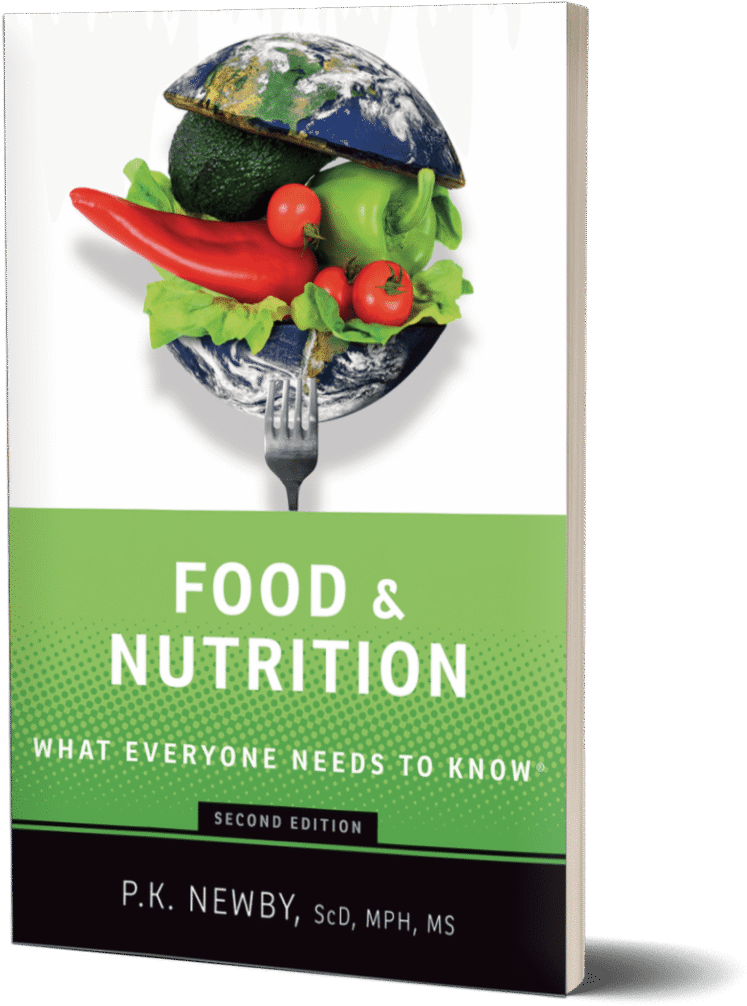
Three-dimensional cover of Food & Nutrition: What Everyone Needs to Know by P.K. Newby, second edition.

Book Summary

From plant-based meat to ultra-processed foods, GMOs to grass-fed beef, our newsfeeds abound with food and nutrition advice—and a lot of it just isn’t true. From sensational headlines to social media anecdotes, misinformation doesn’t make it easy for eaters just trying to get a healthy meal on the table.  Meanwhile, congested food environments fuel incessant consumption, making everyday diets more like an all you can eat buffet—and not in a good way.

There is an urgent need for evidence-based guidance that nurtures good health, wellbeing, and green eating, and Harvard- and Columbia-trained scientist and food lover Dr. P.K. Newby heeds the call. In Food and Nutrition: What Everyone Needs to Know, Newby cuts through confusion, addressing 158 bite-sized questions on why what we eat matters, farm to fork and far beyond.  With wisdom and wit, Newby shines a spotlight on today’s food challenges while showing that the whole diet is greater than the sum of its parts, and one size doesn’t fit all.  The book applies an ecological lens, delving into the interconnected aspects of health, environment, economy, and society, reminding that food isn’t just medicine, nor is individual nutrition its only offering.  The second edition dives deeper into the global agrifood system, revealing striking new data on plant-based diets, longevity, and sustainability; food and mental health; diet, COVID-19, and immunity; mega-factory-farming and climate change; and ultra-processed foods and chronic disease.

Newby’s passion for all things food shines through it all—and so does her belief in the indomitable power of the human spirit, science, and technology to create healthy and sustainable diets for ourselves, our future, and for the planet we share.

The time for the next food revolution is now. Ready to pick up your fork?

Black-and-white portrait of Dr. P.K. Newby.
Book Description
  • Explains the roles of key nutrients, foods, beverages, and dietary patterns for health, sustainability, and disease prevention
  • Guides readers on how to recognize and ditch disinformation and junk science
  • Examines the relationship between humans, food, and the environment across time, space, culture, and place
  • Discusses why contemporary food and nutrition problems exist and how they might be solved
  • Presents a rich framework for considering the interrelationships between science, technology, and eaters in a healthy and sustainable food future for all
 
New to this Edition
  • Completely updated and reorganized to emphasize the critical role of diet on chronic disease and climate change in an era of misinformation
  • Highlights advances in nutrition and agricultural science and technology shaping the global agrifood system
  • New data on plant-based diets, longevity, and sustainability; food and mental health; diet, COVID-19, and immunity; megafactory farming and climate change; and ultra-processed foods and chronic disease
PREFACE. Confused about What to Eat for Good Health and a Green Planet? The Truth Is Out There

Not sure what to eat for health, longevity, and sustainability?  Do you feel like diet advice is constantly changing, or yearn for evidence-based information but don’t know what to believe?  You’re not alone.  It’s not easy to sort fact from fiction given the epidemic of misinformation fueled by self-appointed gurus, Hollywood celebrities, personal trainers, social media influencers, snake oil salespeople, physicians with next to no training in nutrition, evangelical preachers, even world leaders . . . and your mother.  Eaters hunger for answers, and science will happily provide them herein, but the din of junk diet advice is deafening—and it’s a big reason why so many are perplexed.  Nutrition confusion runs rampant, and there is a vital need to bring science to the forefront of contemporary conversations, and it’s exactly what drives me to help savvy readers like you get the food facts.

The truth is that there is much more scientific consensus on diet, disease, and climate change than nay-sayers would have you believe.  Did you know that at least 80% of heart attacks and strokes are preventable, as well as 40% of cancers?  Or that almost 100% of obesity and type 2 diabetes are avoidable? And diet is one of the leading modifiable risk factors for all of them! Yet mistrust in science has risen since this book’s first release, alongside eroding faith in governmental organizations. Fear not, reader!  In Food and Nutrition, we again journey through time and space, culture and place, where you’ll discover the powerful knowledge of how and why what we eat matters, farm to fork and far beyond.  With this book as your trusty guide, obligatory bad food puns peppering your path to knowledge, you’ll finally bid farewell to nutrition nihilism for good.

The book, the first edition now published in Chinese and Turkish, is the culmination of decades of deep thinking about food in my career spanning the social, biological, and public health sciences, beginning with a 12-year academic marathon including a bachelor’s of science in social welfare concentrated on psychology and sociology; two masters degrees in public health and human nutrition; and a doctorate of science from Harvard focused on nutritional epidemiology and diet and disease prevention. I always wanted to be a scientist and professor (if not culinary goddess), and I leaned in hard. Several classes were life-changing—notably, the philosophy of science and the history of public health that permeate this work—but none more so than a course called Nutritional Ecology. It was the mid-1990s, and I was a bright-eyed graduate student at Columbia gobbling up every bit of knowledge I could about all the food things.

The class rocked my world (view), a Eureka! moment that indelibly changed my life—and altered the course of my calling.  Nutrition ecology, a four-quadrant framework encompassing health, environment, society, and economy, became the organizing philosophy for the many courses I developed over the years at Harvard and elsewhere, working to change the paradigm of how we think about food and nutrition.  The idea that food impacts far more than your own health, even our planet, is not new yet remains eye-opening for so many—and it’s finally catching on.  My ardent hope is that this book does for you what that class did for me.

Much has changed dramatically since then, even from this book’s first release.  We’re living in the wake of a global pandemic amid ongoing major geopolitical conflicts and massive zoonotic disease outbreaks—some of which you may not have heard about—yet it’s part of why your eggs are so expensive, and why hunger, food insecurity, and famine are all on the rise.  One morsel of hope is that more eaters are taking a closer look at what’s on their plate and how it got there.  There’s mounting awareness that our global agrifood system is a major culprit in our food polycrises—what I call agshittification—causing widespread damage to the air, land, and water necessary for the survival of our species and others.  And fossil fuel-dependent, megafactory farming is a leading player in our climate change crisis and chronic disease epidemic, alongside intensifying antibiotic resistance that threatens our species and others.

This entirely updated and reorganized second edition meets the moment with the urgency it requires, digging even deeper into the global agrifood system with stand-alone questions that you can consider individually. Or you can read the book cover to cover, if you wish (which would be delightful given it’s “what everyone needs to know” and all).  In these pages you’ll discover striking new data across the board, from plant-based diets, longevity, and sustainability to food and mental health, megafactory farming and climate change to ultra-processed foods and chronic disease. There’s even a plot (in a nonfiction kind of way), its surreal setting our own Age of the Chicken, our fossilized poultry-bone encrusted Earth, its landscape dotted with 26-foot high skyscrapers full of pigs and other grotesque Fourth Agricultural Revolution animal farms-cum-megafactories.

This is not hyperbole, it is our contemporary agrifood system—and one I couldn’t have imagined when I first glimpsed the future of food in Harvard’s Vision: Essays on our Collective Future in 2003.  At the same time, mind-bending advances in science and technology still raise the same existential questions about the world we live in and where we’re headed as a species.  My view is nevertheless the same now as it was then: Homo sapiens must embrace an ecotechno paradigm blending ecological ideals with technologic tools in order to create a healthy and sustainable food future here on Earth.

Yet the upsurge in misinformation and ongoing War on Science—now part of an even more nefarious War on Truth in America and elsewhere—compromises our collective ability to move forward, enlightened by facts.  So you might stumble across data in this book that doesn’t fit your current views. In such cases, I respectfully request you to examine the source and basis of your opinions, open your mind, and perhaps heed the words of Yoda (if not me), who implores: “You must unlearn what you have learned.” (I’m pretty sure the sage Jedi Master of Star Wars was paraphrasing twentieth-century futurist Alvin Toffler—“The illiterate of the twenty-first century will not be those who cannot read and write, but those who cannot learn, unlearn, and relearn”—which is also spot-on in today’s information society.)

Because here's the thing: Science is not a system built on faith and unknowable truths.  It is a systematic method of inquiry that over time, creates a rich body of information illuminating the way the world works.  And it’s true whether you believe it or not.  In the case of food and nutrition, this knowledge has the potential to save your life.  I sincerely hope that this book answers your most pressing questions while also tuning you in and turning you on to all of the other food things happening that you may not have noticed.  My ultimate dream, however, what drove my deep research, day in, day out, is that my book inspires you to take action: for your life, your loved ones, your community, and the shared planetary home we call Earth.

The fact is that our species has arrived at a critical turning point in human history, yet science and climate change denialism are on the rise. But the truth is out there, and in here, written in these way-too-many pages with as much wit as the subject provides (and colorful language, as my editor allows). Let there be no mistake: The food is now. And it is everyday eaters like you and me who create the future of food with each choice we make, every bite we take. Therefore I must—must!—believe that in a time not too distant from now, sapiens will have embraced practices that protect eaters, farmworkers, animals, and the only planet we (currently) inhabit. Will you add your voice to the growing chorus of individuals striving to create a healthy and sustainable food system not just for yourself, but for everyone and everything? Will you join in our crusade, in whatever ways you can?

Yet, as I complete this book with these (literal) last words, some sixteen months after I began writing, it’s clear that agrifood system transformation is just one of many changes we desperately need to move forward as a species, to evolve beyond the chicken age.  Today’s food fight is situated within the larger context of sociopolitical upheaval and unrest, as ultrawealthy individuals in positions of power are placing profits over people while dismantling the evidence-based policies and regulations that have supported the extraordinary gains in health, disease prevention, and longevity humans have enjoyed over the past 100+ years—much of them rooted in science, technology, and the innovative human spirit.

But—as always—the revolution will not be televised.

So I must raise my voice even louder, hoisting the red flag of resistance ever higher, inviting you to the take your place at the table, together with me—while empowering you to seize the opportunity, with every meal, to create the world we wish to see.

Ready to pick up your fork?

—P. K. Newby, ScD, MPH, MS

Inside the Book

I

Introduction: The State of Food, Nutrition, and the Environment

Think about it:  Do you really have any idea who actually grows and produces the foods on your plate, from farm to fork?  Our global food supply is more plentiful than ever, offering choices unimaginable to generations before.  Yet many of the challenges H. sapiens has faced throughout history still affect the majority of the world’s 8.2 billion human inhabitants.  And a range of new health conditions has emerged as a function of longer lives and shifting lifestyles, including heart disease, cancer, stroke, and obesity.  At the same time, grave environmental damages to land, air, and water caused by fossil-fueled agrifood production and farming threaten Earth’s ecosystems and future generations alike, climate change to antimicrobial resistance and beyond.  What is the state of food and the environment at the first quarter-mark of the twenty-first century?  What has changed in the wake of a global pandemic amid major geopolitical conflicts? Who runs our food system, what natural resources are used, and what are the planetary effects? And how do we know what’s true?  (Spoiler alert: Because science.)

Show ChaptersHide Chapters
II

Dining Throughout Human History: Science, Technology, Eater, Environment

Over the course of evolution, H. sapiens has forged relationships with the natural environment to nourish themselves and build civilizations and societies.  At the same time, our species has developed increasingly ingenious tools and technologies enabling groundbreaking ways of feeding an expanding population, especially as more of us flock to cities.  And we’ve made mind-bending scientific discoveries furthering our understanding of how the world works, from harnessing fire to sequencing the human genome to making meat without killing an animal.  Everything about food continues to evolve—how we grow, shop, eat, dine, prepare, and dispose of it—while novel digital and food innovations still raise the same existential questions about what role technology should play in society.  By the time sapiens arrived at the Fourth Industrial Revolution, our own time, the family farms and small-town grocery stores of yesterday are largely gone, our interconnected world dominated by a behemoth agrifood system that utilizes gargantuan automated operations and global economies to feed, if not nourish, those of us who can afford and access food and water.  Science and tech nonetheless march forward, pioneering new ways of producing food while providing a tantalizing array of options that intersect with human wants, needs, and desires that suit our individual tastes, lifestyles, and wallets.  With so many competing demands beyond nutrition and never-ending diet buzzwords—what’s the truth about ultra-processed and organic food?—this section sifts evidence-based diet guidance from social media twaddle to inform healthy and sustainable choices.  Because science.

Show ChaptersHide Chapters
III

Nutrition 101: Essential Building Blocks, Ecological Context

While many subfields of nutrition have emerged, the discipline is rooted in the life sciences, traditionally focused on the mighty micronutrients and phytonutrients and the major energy sources (fat, carbs, protein).  These naked-to-the-human-eye chemicals are carried within the food and drink we eat and are the power sources of our everyday diets.  There are six essential classes of nutrients, beginning with water, utterly critical and often unappreciated.  Alcohol is not necessary, though it may seem so to some, yet it is another overlooked macronutrient that comprises a meaningful portion of calorie intake in some diets (and causes cancer).  It’s all chemistry, and this primer provides the necessary background for understanding how diet ultimately influences health and disease.  And we know so much more about these nutrients than ever before! Not all fats are created equal, nor are carbs and proteins, and their (biochemical!) differences in how they act are at the heart of why it matters for your health and well-being.  A nutritional ecology model expands the lens beyond our individual brains and bodies by considering key environmental, economic, and societal factors surrounding these fundamental building blocks of nutrition—from orangutans to palm oil to plastics to pretty much everything else. Part VI provides evidence-based guidance on disease prevention, weight loss, longevity, and food waste while highlighting ecotechno solutions for creating healthy, sustainable food systems, from agroecology to alternative proteins to artificial intelligence, urging that the time for revolution is now.

Show ChaptersHide Chapters
IV

Food, Glorious Food: The Powers and Pleasures of Plant-Based Diets

H. sapiens has long indulged in rituals featuring brews like coffee and tea and chocolate, from sacred spiritual practices to simply socializing—or perhaps just to begin another day.  Beyond our beloved beverages, the plant kingdom offers beautiful to behold vegetables, fruits, beans, nuts, and whole grains in all their wondrous guises.  Sapiens boasting meat’s nutritional offerings as superior to plants are sorely mistaken, its Paleo roots misplaced.  This rising interest in plant-based diets is due to the scientific consensus that transforming human diets back toward the plant kingdom is critical to control chronic diseases, combat climate change, and regenerate our planet.  Learn the facts about how plants promote health, prevent disease, and provide pleasure—and why they’re at the heart of a healthy and sustainable diet.  Still, some are better than others when it comes to how those plants got to your plate, raising opportunities to make eco-conscious choices that matter far beyond your (obligatory) caffeine fix.

Show ChaptersHide Chapters
V

All About Animal Foods: Megafactory Farm to Fork and Beyond

Our omnivorous species evolved largely eating plants until sorting out how to hunt and raise animals for food, including their eggs and milk (and sometimes their babies). In the twentieth century, H. sapiens figured out how to farm animals en masse and is now taking things to new levels—or 26, in the case of vertical pig farming. Yet there is little awareness of how that mouthwatering bacon double-cheese burger came to be, which is from a megafactory farm you haven’t allowed yourself to fathom. Because no one wants to (and certainly not I), the uncomfortable truth that while there may not be a packaging label on that ground-up cow, there is nothing natural at all about it. Industrial meat is the ultimate ultra-processed food with ingredients you aren’t told about—why is that?—carrying heightened health risks in the form of cardiovascular disease, foodborne illness, cancer, and antibiotic resistance. And all the while directly contributing to climate change. Leaving aside the ethics of eating animals, if you wish, there is overwhelming evidence and scientific consensus that industrial animal factories are threatening the things we hold dear: our health, our environment, our neighbors, our societies, our planet—and perhaps even our humanity.

Show ChaptersHide Chapters
VI

The Food Revolution: Creating Healthy and Sustainable Diets for All

Welcome to the food revolution, where H. sapiens has the tools and know-how to build a brighter future for our species and all the Earth’s inhabitants—if we choose, collectively, to do so.  The keys to fix our broken agrifood system, not to mention your own health, are within our reach.  Organizations and nations around the world are fighting the good food fight to combat malnutrition in all its forms, cut food waste, prevent disease, curb climate change, and boost health and well-being.  How will evolutions in science and developments in technology dovetail with changes in consumer lifestyles and preferences to create the ecotechno future we need?  What can you do to create your own best health, body, mind, and spirit?  And how can we transform our food systems to ensure we can sustainably feed future sapiens while also nourishing our shared planetary home?  It’s up to us humans here in the present to step up our food game and catapult our species beyond skyscrapers full of pigs in our own Age of the Chicken and create a healthy and sustainable food system for all. .

Show ChaptersHide Chapters

How to Buy

Bookshop.org is an excellent way to support your favorite bookstore if you can't get to it in person.  Other purchase options follow, with direct links to the book.  Please reach out for bulk orders.

Hands sharing a colorful meal of vegetables, grains, fruit, and drinks around a dining table.

Subscribe to Food Truth, Unfiltered to stay in the know on all the food things. No paywall, and we’ll never sell your email.

Dr. P.K. Newby

Founder and CEO Dr. P.K. Newby is a Harvard- and Columbia-trained nutrition scientist and author of Food & Nutrition: What Everyone Needs to Know. She writes Food Truth, Unfiltered, a free newsletter on Substack.

Scroll To Top